Web Interface
What is the Web Interface?
The Web Interface is the browser version of luckycloud. You can access it by logging into your luckycloud account via our website.
How do I upload data via the Web Interface?
- Log into your luckycloud account via our website.
- You are now in your customer dashboard. Navigate with the mouse to the "Cloud Storage" tab (top right) and click on it.
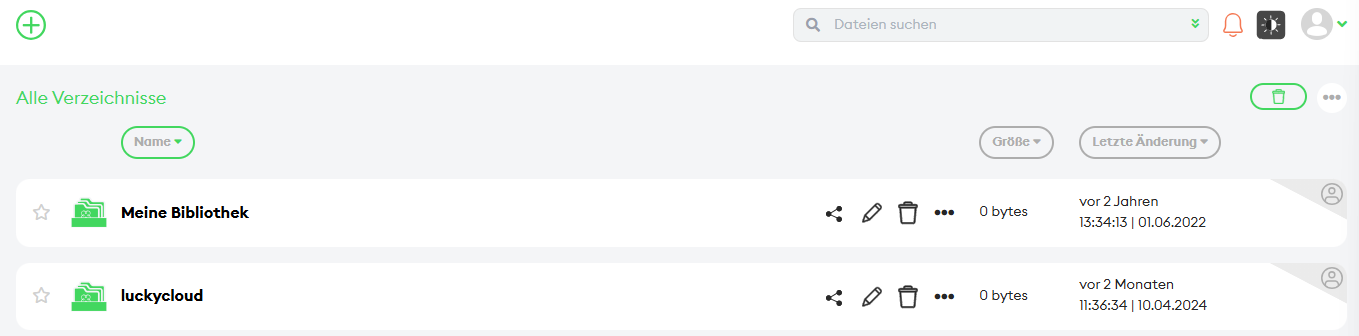
- You are now in the overview of your cloud storage. Here you can create a new directory using the "New Directory" button (green "+" symbol at the top left).
- Here you can assign a name to the directory.
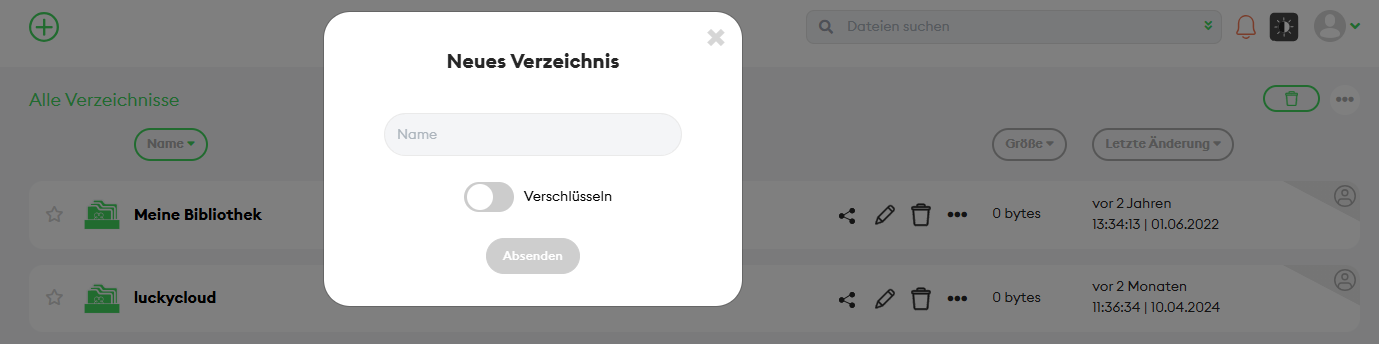
- Optionally, you can also encrypt the directory. To do this, you must activate the slider at "Encrypt" and set a password. This way, only people who have the password can access the directory.
Note: End-to-end encryption is only available when using the sync client. In the browser version, the data is encrypted only on the server.
- Open the newly created directory and upload files or folders via "Drag & Drop" or using the "Upload" button (green arrow at the top left next to the "+" symbol).

- A pop-up window opens, and you can choose whether to upload files or entire folders.
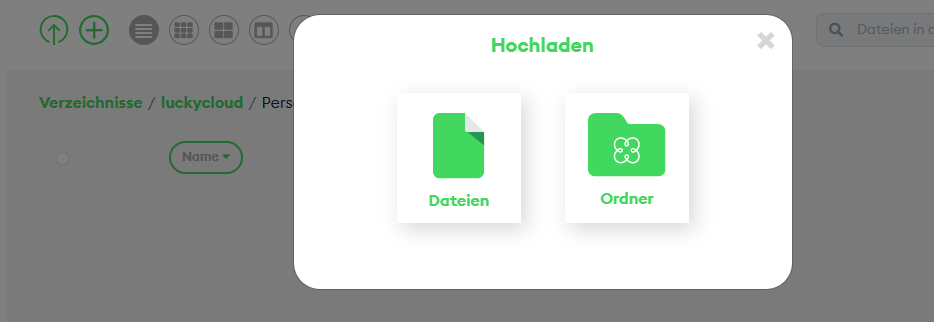
- Select one of the two options, and your Windows Explorer/Finder (macOS) opens. Select the appropriate data and upload it.
Note: An encrypted directory cannot be decrypted again. Encryption is a one-time process, like a fingerprint, which is irreversible. To decrypt the data in the directory, you must upload it to a completely new directory.
Edit Documents Online in the Web Interface
In the luckycloud web interface, you can open and edit documents directly in your browser. No additional software is required. This feature is especially useful if you want to make quick changes or collaborate on documents with others.
Open a Document in luckycloud Cloud Storage (Web Interface)
To edit a document:
- Log in to luckycloud cloud storage (web interface).
- Navigate to the folder where your document is stored.
- Click the file you want to open.
The document will open automatically in your browser.

Edit Documents Online in the Browser
Once a document is open, you can edit it directly in your browser. Changes are saved automatically. If multiple people have access to the file, they can work on it at the same time.

You can find information about sharing files here: Share Files and Folders
Supported File Formats in the Browser Editor
The browser editor supports common Office file formats:
- .docx – text documents
- .xlsx – spreadsheets
- .pptx – presentations
Other file formats can usually only be viewed or downloaded in the web interface.
When Editing Documents in the Browser Makes Sense
Editing in the browser is especially useful if you:
- want to make quick changes to documents
- are collaborating on a file with others
- access documents from different devices
If you prefer to edit documents locally, you can use the Sync Client instead.
You can find more information here: Synchronize Files with the luckycloud Sync Client
How do I clear the browser cache?
If the page does not display correctly, you need to clear the browser cache. Depending on the browser and operating system, the following key combinations are available:
| Browser | Windows | macOS | Linux |
|---|---|---|---|
| Mozilla Firefox | Ctrl + Shift + Delete | Cmd (⌘) + Shift + R | Ctrl + Shift + Delete |
| Google Chrome | Ctrl + Shift + Delete | Cmd (⌘) + Shift + Backspace | Ctrl + Shift + Delete |
| Microsoft Edge | Ctrl + Shift + Delete | Cmd (⌘) + Shift + Backspace | Ctrl + Shift + Delete |
| Safari | - | Cmd (⌘) + Option + E | - |